The Insight of an American Historian, H.W. Brands
Who
is your favorite president? Is it one of the Rushmore titans,
Washington, Lincoln, and company? Or do you have a soft spot for Jimmy
Carter or Nixon? Several months ago, Historian H.W. Brands gave a
lecture on this topic at the Hauenstein Center. His criteria for
presidential greatness is fascinating, although I disagree with some of
it.
Brands' criteria for measuring presidential greatness consists of the following:
*Did the president meet the expectations of the presidency in his contemporary age?
*Did the president have a greater impact on American life and history compared with his recent predecessors and successors?
*Did the president face a crisis great enough to shake the foundations of American life?
*Many
things happen in American life which have nothing to do with the U.S.
Constitution. In such cases, did the president find a solution that the
Constitution didn't provide for?
*The
great presidents were dividers, not uniters. Did the president use
divisiveness cleverly enough to get elected and re-elected?
It seems fair to judge a president's leadership against
the expectations of his day and age. Technology and global connections
are of a far different nature than they were in George Washington's day.
On the flip side, there is a danger in a leader always giving in to the
demands of the crowd. Presidents are elected because people trust them
to have greater wisdom [than themselves] to make the big decisions. A
president must keep this in mind when opinion polls swing one way, then
the other.
Having a greater (or transformative) impact on American
life seems a prerequisite for greatness. After all, biographers and
textbook writers need stories to tell. Still, Brands may take this a
little further than caution should counsel. Adolf Hitler and Genghis
Khan had a transformative impact on world history. Yet, we don't hold
them in high esteem (to put it mildly).
Brands is not alone among historians who claim a great,
earth shattering crisis is essential to providing a president with
sufficient opportunity to bring out his greatness. George Washington,
Abraham Lincoln, and FDR are placed at the top of most academic lists of
presidential greatness precisely because each of them had to tackle a
crisis that put the existence and/or prosperity of America at risk.
Brands concurs.
This view
deserves to be challenged, and some have made the case for presidents
Theodore Roosevelt, Dwight Eisenhower, and Ronald Reagan, who avoided a
major war and fostered prosperity during two terms. Drama and crisis
need not be a criteria for greatness. There are other means through
which a major impact (if quietly) can be made on the world, namely
through smart diplomacy, sound economic policies, and the preservation
and expansion of human freedom. It was not for nothing that Eisenhower
didn't use an atomic bomb on another nation during his presidency, or
that bloodshed didn't accompany the fall of the Iron Curtain in Europe
during Bush's term.
Historians are impressed by those who are ambitious for
power and are successful in gaining it. More than two thousand years
after his assassination on the floor of the Roman senate (by those less
impressed than historians with people hungry for power) Julius Caesar
has had no shortage of doting biographers. Brands falls victim to this
spell by asserting presidential greatness depends on a willingness to
set aside Constitutional scruples to find solutions to the problems of
the day.
To this point I must
reply that the U.S. Constitution was designed to function the way it
does precisely in the name of avoiding an American Caesar. The fact that
the U.S. Constitution is the oldest (currently functioning) political
constitution in the world, and has produced a society with a level of
freedom that continues to expand to include ever greater numbers of
people (some of them here illegally) is a testament that this document
offers solutions to the problems of any day and age. Presidents should
not be encouraged to seek solutions outside those permissible under the
Constitution.
More troubling is Brands' assertion that the great
presidents were dividers rather than uniters, and that a president
aspiring to greatness must be divisive. Of the three greatest presidents
(in Brands' reckoning), the one he uses most convincingly for this
argument is FDR. At the Hauenstein Center, Brands called the audience's
attention to President Obama's re-election campaign in 2012. The
historian correctly explained that the current president resorted to
tactics "we might call class warfare." But Brands believes Obama's
demagoguery was tame compared to the class warfare employed by FDR in
his successful campaigns in 1932 and 1936. Roosevelt spoke of
"moneychangers" and "economic royalists" who were to blame for the Great
Depression, and that Roosevelt was determined to rein them all in.
Regardless of how one may compare Obama's class warfare
with FDR's, it is hard to accept Brands' claim that divisiveness is a
hallmark of presidential greatness. Of anyone who reveres the memory of
FDR, I doubt dirty political fighting is one of their reasons for
admiring him.
Harder still, is
the case that the other great presidents, Washington and Lincoln, were
divisive leaders. Washington was unanimously elected to be the nation's
first president precisely because he was the only revolutionary figure
all prominent Americans could unite behind. Divisiveness was rampant
during the Civil War because it was a civil war. But Lincoln could
hardly be blamed for it considering the southern states left the union
merely because he was elected president in the first place. Furthermore,
as the war drew to a close, Lincoln's reconstruction plans called for
lenient treatment of the states being brought back into the union. There
would be no treason trials.
H.W.
Brands' criteria for assessing presidential greatness is insightful
because it reveals the way historians view human relations. Like others,
historians tend to be obsessed with power and are impressed by those
who wield it. They call our attention to those who organize and use
people. Historians can be of great use in helping us make up our minds
about our leaders, clarifying our own views of them, even if those views
are contrary to those of the historian.
Patriot Thought
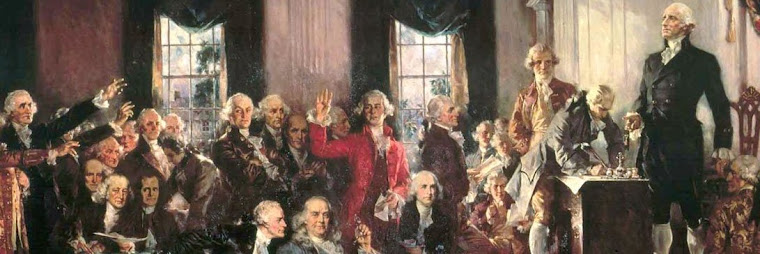
Howard Chandler Christy Depicts The Founders Signing The U.S. Constitution on September 17, 1787. "Scene at the Signing of the Constitution of the United States" (1940)
Showing posts with label Presidential Comparisons and Contrasts. Show all posts
Showing posts with label Presidential Comparisons and Contrasts. Show all posts
Tuesday, July 30, 2013

Saturday, July 27, 2013
How Does One Become A Great Historical Figure?
The Insight of an American Historian, H.W. Brands
Having read the work of many popular historians of American history, I've concluded H.W. Brands stands out among them. Biographers tend to fall in love with their subjects, a condition David McCullough mildly suffers from. In reading his Pulitzer-winning masterpiece John Adams, a critical thinker could not help but notice the author would have us believe politics played no role in President Adams' appointment of a large number of midnight judges, shortly before his adversary (Thomas Jefferson) was inaugurated to take his place as president.
So what if Adams was politically motivated in stacking the courts with judges of his ideological bent the night (or weeks) before leaving the presidency? As president, he had the right to make those appointments. Yet, McCullough felt the need to defend his biographical subject, even on such a benign issue. A cynic may think the author has become the parent of his subject. Such parental protectiveness is less apparent in Brands' works of history (if it is detectable at all).
H.W. Brands is one of my favorite historians because he tackles both sides of every major controversy without imposing his judgement heavily on one side. His handling of President Andrew Jackson's role in the forced removal of the Indian nations to places west of the Mississippi, what we might today call ethnic cleansing, (without the genocidal purpose which often accompanies it) is fascinating because Brands shows us the dilemmas each of the major participants had, and what their options were. The result was that the tragedy of the Indian removal was conveyed to the reader without a biased or slanted judgement toward one party or another. I happen to believe the state of Georgia behaved shamefully and fraudulently in its instigation of that crisis, but Brands didn't force me to make that conclusion.
Recent history is the litmus test of a historical writer's even-handedness. During a time-killing walk through the history section of a local Barnes and Noble, I perused a copy of Brands' American Dreams: The United States Since 1945. Subjecting it to the ultimate test of fairness, I went straight to the chapters covering 1980 - 2009. I discovered the book is striking for its even-handedness in treating presidents as controversial as Reagan, the Bushes, and Obama. The same can not be said for other historians who have written good work on the same history, Paul Johnson and Sean Wilentz to name a few.
Although recognizing Reagan never saw a weapons order he didn't like (contradicting his pledge to dramatically reduce the deficit), Brands conveys the Reagan presidency on all its merits, good and bad. By contrast, Paul Johnson's overwhelming praise for Reagan, and his excessive sympathy for Nixon, is matched by his dripping contempt for FDR and JFK. Nevertheless, Johnson's History of the American People is a fantastic (and vital) exploration of American history, aside from its flaws.
Sean Wilentz's Age of Reagan has the same problems, although from a liberal angle. His chapters on Reagan are chock full of stories about government corruption, yet that theme disappears when the reader gets to the Clinton chapters, as if the arrival of a Democrat president suddenly cleanses the sins of a corrupt bureaucracy. For ideological balance, Brands' work stands out from the rest. Brands is the type of writer who would come across as liberal to a conservative reader and conservative to a liberal reader, a quality unique and refreshing in an age of partisan extremes coloring information coming from today's media.
H.W. Brands has written biographies on Benjamin Franklin, Andrew Jackson, Ulysses Grant, Theodore Roosevelt, FDR, and is currently working on one about Reagan. Taken together, these six biographies will represent a view of the entire history of America through the prism of the presidency (excepting Ben Franklin, although he was a dominant political figure of his age).
Brands is a professor of history at the University of Texas. His students are mainly undergraduates. He is a prolific speaker at colleges across the country. Many of his public lectures are available on youtube. From listening to his lectures, one gains remarkable insight into the way a presidential historian assesses leadership qualities. Regardless of one's aspirations in life, Brands helps us understand the qualities that make someone a great historical figure.
Of particular interest is what Brands calls "the half-step rule." Have you ever realized you may be conflicted in your own views of a historical figure? For example, there are some qualities of that person's character you find admirable, and other qualities which contradict, or work against the quality you think is likeable in that character? To be more specific, let's take Thomas Jefferson's lofty words, "We hold these truths to be self-evident that all men are created equal" with his vehement denunciations of slavery in that he "shuddered" to think "God is just" and that there will be a "reckoning" regarding slavery. Now, on the other hand, how do we square Jefferson's words with the reality that he owned well over a hundred slaves, and was dependent on their labor until the day he met the maker he knew would bring the reckoning for it?
Doesn't it seem contradictory that history is moved by some of the very people you would least expect to move it? If so, Brands' answer is the half-step rule. He explains that history moves in half-steps. For a person to become a truly great historical figure, he or she must have one foot planted in the future, while keeping the other foot rooted in the present. If both feet are planted in the future, a person's contemporaries will think he or she is out of touch with reality, or too radical, and therefore impressionable minds will not be impressed. A person who is a full-step ahead of his times will never have the opportunity to become a historical figure, at least not a great one because his impact will not be large enough.
The key to greatness is to be a half-step ahead of the times, keeping enough common ground with contemporaries to convince them of the change you want them to accept. Future generations will struggle to square what they will see as contradictions in your character, but the fact that they will struggle with it (at all) is a testament to your impact as a great historical figure.
If Jefferson hadn't owned slaves, he never would have been among the planter class that ruled Colonial Virginia. Therefore, Jefferson would never have been elected to Virginia's House of Burgesses. From there, it follows that he never would have been selected to go to the Continental Congress. Therefore, he never would have been appointed to the committee drafting the Declaration of Independence. Finally, Jefferson would never have set America on the ideological footing of liberty and equality for all (men), putting slavery on the permanent defensive. Other men may have accomplished this, but Jefferson would not have, had he not owned slaves. A great figure is not good in all his attributes, yet without certain (if unpleasant) attributes, he never becomes great.
Patriot Thought
Having read the work of many popular historians of American history, I've concluded H.W. Brands stands out among them. Biographers tend to fall in love with their subjects, a condition David McCullough mildly suffers from. In reading his Pulitzer-winning masterpiece John Adams, a critical thinker could not help but notice the author would have us believe politics played no role in President Adams' appointment of a large number of midnight judges, shortly before his adversary (Thomas Jefferson) was inaugurated to take his place as president.
So what if Adams was politically motivated in stacking the courts with judges of his ideological bent the night (or weeks) before leaving the presidency? As president, he had the right to make those appointments. Yet, McCullough felt the need to defend his biographical subject, even on such a benign issue. A cynic may think the author has become the parent of his subject. Such parental protectiveness is less apparent in Brands' works of history (if it is detectable at all).
H.W. Brands is one of my favorite historians because he tackles both sides of every major controversy without imposing his judgement heavily on one side. His handling of President Andrew Jackson's role in the forced removal of the Indian nations to places west of the Mississippi, what we might today call ethnic cleansing, (without the genocidal purpose which often accompanies it) is fascinating because Brands shows us the dilemmas each of the major participants had, and what their options were. The result was that the tragedy of the Indian removal was conveyed to the reader without a biased or slanted judgement toward one party or another. I happen to believe the state of Georgia behaved shamefully and fraudulently in its instigation of that crisis, but Brands didn't force me to make that conclusion.
Recent history is the litmus test of a historical writer's even-handedness. During a time-killing walk through the history section of a local Barnes and Noble, I perused a copy of Brands' American Dreams: The United States Since 1945. Subjecting it to the ultimate test of fairness, I went straight to the chapters covering 1980 - 2009. I discovered the book is striking for its even-handedness in treating presidents as controversial as Reagan, the Bushes, and Obama. The same can not be said for other historians who have written good work on the same history, Paul Johnson and Sean Wilentz to name a few.
Although recognizing Reagan never saw a weapons order he didn't like (contradicting his pledge to dramatically reduce the deficit), Brands conveys the Reagan presidency on all its merits, good and bad. By contrast, Paul Johnson's overwhelming praise for Reagan, and his excessive sympathy for Nixon, is matched by his dripping contempt for FDR and JFK. Nevertheless, Johnson's History of the American People is a fantastic (and vital) exploration of American history, aside from its flaws.
Sean Wilentz's Age of Reagan has the same problems, although from a liberal angle. His chapters on Reagan are chock full of stories about government corruption, yet that theme disappears when the reader gets to the Clinton chapters, as if the arrival of a Democrat president suddenly cleanses the sins of a corrupt bureaucracy. For ideological balance, Brands' work stands out from the rest. Brands is the type of writer who would come across as liberal to a conservative reader and conservative to a liberal reader, a quality unique and refreshing in an age of partisan extremes coloring information coming from today's media.
H.W. Brands has written biographies on Benjamin Franklin, Andrew Jackson, Ulysses Grant, Theodore Roosevelt, FDR, and is currently working on one about Reagan. Taken together, these six biographies will represent a view of the entire history of America through the prism of the presidency (excepting Ben Franklin, although he was a dominant political figure of his age).
Brands is a professor of history at the University of Texas. His students are mainly undergraduates. He is a prolific speaker at colleges across the country. Many of his public lectures are available on youtube. From listening to his lectures, one gains remarkable insight into the way a presidential historian assesses leadership qualities. Regardless of one's aspirations in life, Brands helps us understand the qualities that make someone a great historical figure.
Of particular interest is what Brands calls "the half-step rule." Have you ever realized you may be conflicted in your own views of a historical figure? For example, there are some qualities of that person's character you find admirable, and other qualities which contradict, or work against the quality you think is likeable in that character? To be more specific, let's take Thomas Jefferson's lofty words, "We hold these truths to be self-evident that all men are created equal" with his vehement denunciations of slavery in that he "shuddered" to think "God is just" and that there will be a "reckoning" regarding slavery. Now, on the other hand, how do we square Jefferson's words with the reality that he owned well over a hundred slaves, and was dependent on their labor until the day he met the maker he knew would bring the reckoning for it?
Doesn't it seem contradictory that history is moved by some of the very people you would least expect to move it? If so, Brands' answer is the half-step rule. He explains that history moves in half-steps. For a person to become a truly great historical figure, he or she must have one foot planted in the future, while keeping the other foot rooted in the present. If both feet are planted in the future, a person's contemporaries will think he or she is out of touch with reality, or too radical, and therefore impressionable minds will not be impressed. A person who is a full-step ahead of his times will never have the opportunity to become a historical figure, at least not a great one because his impact will not be large enough.
The key to greatness is to be a half-step ahead of the times, keeping enough common ground with contemporaries to convince them of the change you want them to accept. Future generations will struggle to square what they will see as contradictions in your character, but the fact that they will struggle with it (at all) is a testament to your impact as a great historical figure.
If Jefferson hadn't owned slaves, he never would have been among the planter class that ruled Colonial Virginia. Therefore, Jefferson would never have been elected to Virginia's House of Burgesses. From there, it follows that he never would have been selected to go to the Continental Congress. Therefore, he never would have been appointed to the committee drafting the Declaration of Independence. Finally, Jefferson would never have set America on the ideological footing of liberty and equality for all (men), putting slavery on the permanent defensive. Other men may have accomplished this, but Jefferson would not have, had he not owned slaves. A great figure is not good in all his attributes, yet without certain (if unpleasant) attributes, he never becomes great.
Patriot Thought
Saturday, December 15, 2012
Blaming Bush: Executive Hypocrisy in the Obama Age
We've all heard President Obama say time and again that he "inherited"
from President Bush "the worst economic crisis since the Great
Depression" and that it takes more than four years or eight years to
"clean up the mess." Blaming Bush has been part of the wiring of the
Obama team since they began campaigning for the presidency in 2007. In
2008, Obama called Bush "unpatriotic" for adding $4 trillion to the
national debt in eight years. He called it "irresponsible" to saddle the
nation's children and grandchildren with debt paid for "by a credit
card from the national bank of China."
Sometimes Obama officials tell the truth when blaming Bush for problems they inherited; other times they lie when blaming Bush for their own poor choices. The most outrageous lie was when Press Secretary Jay Carney stated at a White House press conference (when asked about the calamitous $500 billion-dollar loan made to the now bankrupt Solyndra) that "the process leading to" the Solyndra loan "began under President Bush." The message is the Obama administration is not responsible for any blunder they choose to blame Bush for.
The reality is the Bush administration rejected Solyndra's loan-guarantee request! It was rejected because the administration's budget office told the president Solyndra's financial state was so precarious that the company would be bankrupt in a year's time. President Obama received the same advice from the budget office, but made the loan-guarantee to Solyndra anyway. A loan-guarantee means that the taxpayers co-sign for the loan. In this case, the taxpayers co-signed a $500 billion-dollar loan to a company that couldn't pass the credit check!
Aside from this most flagrantly dishonest example of Bush-blaming, can we still swallow Obama's claim that cleaning-up Bush's mess has been such a huge task that he needed a second term to finish it? Let's examine this claim in a little detail.
The Bush years were not so long ago. It seemed like a rough ride at the time. On 9/11/2001, the Twin Towers and the Pentagon were attacked by terrorists. Three thousand Americans were dead. The same evening, the president of the United States gave a radio address announcing that this country was now in a state of war. I was twenty years old. War was something my generation did not grow up with. The Gulf War of 1991 had only lasted a few weeks and Vietnam had long been in school history textbooks. When I was growing up, politics was bland, uninteresting. It seemed far away. Times had been good.
Then, George W. Bush (43rd president of the United States 2001-2009) led the nation into scary waters. Suddenly, we were fighting a world-wide war against terrorism. Troops by the tens of thousands were sent to Afghanistan and Iraq to defend our freedom and to bring our enemies to justice. War is costly, not just in lives and property, but in finance as well. Republican presidents do not like to raise taxes to pay for increased expenditures. President Bush was no exception. To finance the wars, he borrowed the money instead of charging the American taxpayer. Within a year and a half of the attacks on 9/11, the United States was running record deficits. By the end of the decade, Bush had added $4 trillion dollars to the national debt. This state of affairs could not go on forever. If it did, an eventual run on the dollar would wreck the American economy and make the American dream a thing of the past.
As it turned out, the economy was wrecked by the time the Bush presidency ended, but it was not triggered by the national debt. Another monster had been growing alongside the debt and had received much less attention. This monster was a housing bubble, fed by the availability of sub-prime mortgages. For many years, there had been a collusion between the government and the banks to make mortgage requirements low for lower-income people. Soon, all manner of investment fed off the flourishing mortgage market. Risky mortgage securities were sold, bought, and re-sold again. The entire cycle depended on the ability of the homeowners to pay on the mortgages.
In the summer of 2007, the job market stalled and a wave of foreclosures swept the nation. A year later, the wave arrived at the doors of the major lending houses. Lehman Brothers went under and suddenly the government enacted the Emergency Economic Stabilization Act of 2008 which enabled the U.S. Treasury to spend $700 billion dollars to buy up the risky assets held by the nation's lenders. This influx of cash would save the financial system from collapse. In the coming months, this bailout would be followed-up by additional bailouts of the auto industry. The assumption behind the approach was to save the entire economy by preventing the fall of public and private institutions deemed "too big to fail."
For us to tackle the essential question of whether Obama can blame Bush, we must first ask ourselves what Bush did, what Obama has done, and if their respective approaches to problem-solving were similar or different. President Bush and Senator/President-Elect/President Obama were both at the center of the decision-making behind the bailouts. From September 2008 until January 2009, they worked together and were of the same mind. Bush told Obama the plan he and Treasury Secretary Paulson wanted. Obama agreed and promised to deliver the needed votes from Senate Democrats.
After January 2009, President Obama followed-up the bank bailouts with auto bailouts. Then, his first stimulus bill gave the states an $800 billion-dollar bailout. Soon more, massive infusions of cash into the economy were piped-in.
Four years later, where are we? We are stuck with with high unemployment, a $16 trillion-dollar national debt, and a downgraded credit rating for the United States. (As of 2011, America has lost its AAA credit rating for the first time in history).
Who is to blame? (A) Wall Street Fat-Cats? (B) Republicans? (C) Democrats? (D) Bush? (E) Obama? (F) Poor people who get in-over-their-heads with a mortgage they can't pay? (G) Fannie and Freddie (government sponsored enterprises)? (H) The Federal Reserve?
Everyone shares a part of the blame, but B, C, D, E, F, and H, are much more to blame than A and G. Yet, Wall Street and Fannie/Freddie have had more fingers pointed at them than everyone else has had. This is unfair. Can we imagine ourselves turning down a perfectly good opportunity to legally make a ton of cash from trading mortgage-backed securities, or from any other commodity? Why have so many fingers been pointed at Fannie/Freddie when they just take orders from the government when it comes to setting lending rules? For years Congress, the President (Clinton and Bush), and the Federal Reserve (Greenspan) had pressured Fannie/Freddie and banks throughout the system into making easy mortgage loans.
Bush is to blame for the mushrooming debt and the bloated, risky sub-prime mortgage market that tanked the economy in 2008. But who is Obama to be blaming his own failure to fix the problem on Bush when he worked in tandem with him in growing the debt and by responding to the same crisis with the same measures? Since Obama has taken office as the 44th president, he has added $5 trillion [more than Bush added] to the national debt and the consequence has been a downgraded credit rating for the country. According to his own stated principles, Obama is "unpatriotic" for being "irresponsible" in saddling the nation's children and grandchildren with debt paid for "by a credit card from the national bank of China."
The eventual run on the dollar everyone feared in the Bush years has become an even greater likelihood under Obama. Obama can not turn us away from a headlong sprint toward a cliff by taping-down the gas pedal and keeping us headed in the same direction! There is not a chance he will reverse this state of affairs in the next four years.
Patriot Thought
Sometimes Obama officials tell the truth when blaming Bush for problems they inherited; other times they lie when blaming Bush for their own poor choices. The most outrageous lie was when Press Secretary Jay Carney stated at a White House press conference (when asked about the calamitous $500 billion-dollar loan made to the now bankrupt Solyndra) that "the process leading to" the Solyndra loan "began under President Bush." The message is the Obama administration is not responsible for any blunder they choose to blame Bush for.
The reality is the Bush administration rejected Solyndra's loan-guarantee request! It was rejected because the administration's budget office told the president Solyndra's financial state was so precarious that the company would be bankrupt in a year's time. President Obama received the same advice from the budget office, but made the loan-guarantee to Solyndra anyway. A loan-guarantee means that the taxpayers co-sign for the loan. In this case, the taxpayers co-signed a $500 billion-dollar loan to a company that couldn't pass the credit check!
Aside from this most flagrantly dishonest example of Bush-blaming, can we still swallow Obama's claim that cleaning-up Bush's mess has been such a huge task that he needed a second term to finish it? Let's examine this claim in a little detail.
The Bush years were not so long ago. It seemed like a rough ride at the time. On 9/11/2001, the Twin Towers and the Pentagon were attacked by terrorists. Three thousand Americans were dead. The same evening, the president of the United States gave a radio address announcing that this country was now in a state of war. I was twenty years old. War was something my generation did not grow up with. The Gulf War of 1991 had only lasted a few weeks and Vietnam had long been in school history textbooks. When I was growing up, politics was bland, uninteresting. It seemed far away. Times had been good.
Then, George W. Bush (43rd president of the United States 2001-2009) led the nation into scary waters. Suddenly, we were fighting a world-wide war against terrorism. Troops by the tens of thousands were sent to Afghanistan and Iraq to defend our freedom and to bring our enemies to justice. War is costly, not just in lives and property, but in finance as well. Republican presidents do not like to raise taxes to pay for increased expenditures. President Bush was no exception. To finance the wars, he borrowed the money instead of charging the American taxpayer. Within a year and a half of the attacks on 9/11, the United States was running record deficits. By the end of the decade, Bush had added $4 trillion dollars to the national debt. This state of affairs could not go on forever. If it did, an eventual run on the dollar would wreck the American economy and make the American dream a thing of the past.
As it turned out, the economy was wrecked by the time the Bush presidency ended, but it was not triggered by the national debt. Another monster had been growing alongside the debt and had received much less attention. This monster was a housing bubble, fed by the availability of sub-prime mortgages. For many years, there had been a collusion between the government and the banks to make mortgage requirements low for lower-income people. Soon, all manner of investment fed off the flourishing mortgage market. Risky mortgage securities were sold, bought, and re-sold again. The entire cycle depended on the ability of the homeowners to pay on the mortgages.
In the summer of 2007, the job market stalled and a wave of foreclosures swept the nation. A year later, the wave arrived at the doors of the major lending houses. Lehman Brothers went under and suddenly the government enacted the Emergency Economic Stabilization Act of 2008 which enabled the U.S. Treasury to spend $700 billion dollars to buy up the risky assets held by the nation's lenders. This influx of cash would save the financial system from collapse. In the coming months, this bailout would be followed-up by additional bailouts of the auto industry. The assumption behind the approach was to save the entire economy by preventing the fall of public and private institutions deemed "too big to fail."
For us to tackle the essential question of whether Obama can blame Bush, we must first ask ourselves what Bush did, what Obama has done, and if their respective approaches to problem-solving were similar or different. President Bush and Senator/President-Elect/President Obama were both at the center of the decision-making behind the bailouts. From September 2008 until January 2009, they worked together and were of the same mind. Bush told Obama the plan he and Treasury Secretary Paulson wanted. Obama agreed and promised to deliver the needed votes from Senate Democrats.
After January 2009, President Obama followed-up the bank bailouts with auto bailouts. Then, his first stimulus bill gave the states an $800 billion-dollar bailout. Soon more, massive infusions of cash into the economy were piped-in.
Four years later, where are we? We are stuck with with high unemployment, a $16 trillion-dollar national debt, and a downgraded credit rating for the United States. (As of 2011, America has lost its AAA credit rating for the first time in history).
Who is to blame? (A) Wall Street Fat-Cats? (B) Republicans? (C) Democrats? (D) Bush? (E) Obama? (F) Poor people who get in-over-their-heads with a mortgage they can't pay? (G) Fannie and Freddie (government sponsored enterprises)? (H) The Federal Reserve?
Everyone shares a part of the blame, but B, C, D, E, F, and H, are much more to blame than A and G. Yet, Wall Street and Fannie/Freddie have had more fingers pointed at them than everyone else has had. This is unfair. Can we imagine ourselves turning down a perfectly good opportunity to legally make a ton of cash from trading mortgage-backed securities, or from any other commodity? Why have so many fingers been pointed at Fannie/Freddie when they just take orders from the government when it comes to setting lending rules? For years Congress, the President (Clinton and Bush), and the Federal Reserve (Greenspan) had pressured Fannie/Freddie and banks throughout the system into making easy mortgage loans.
Bush is to blame for the mushrooming debt and the bloated, risky sub-prime mortgage market that tanked the economy in 2008. But who is Obama to be blaming his own failure to fix the problem on Bush when he worked in tandem with him in growing the debt and by responding to the same crisis with the same measures? Since Obama has taken office as the 44th president, he has added $5 trillion [more than Bush added] to the national debt and the consequence has been a downgraded credit rating for the country. According to his own stated principles, Obama is "unpatriotic" for being "irresponsible" in saddling the nation's children and grandchildren with debt paid for "by a credit card from the national bank of China."
The eventual run on the dollar everyone feared in the Bush years has become an even greater likelihood under Obama. Obama can not turn us away from a headlong sprint toward a cliff by taping-down the gas pedal and keeping us headed in the same direction! There is not a chance he will reverse this state of affairs in the next four years.
Patriot Thought
Saturday, December 1, 2012
The Great Depression and Today's Depression
Recession Myths: De-Constructing Historical Falsification
Persuading voters in the middle of a bad economy is an exercise in convincing them government policies actually impact economic health. From there it follows, one candidate is on the right side of economic health and the other candidate is on the wrong side. It is too late to decide for 2012, but history can prepare us for 2014 and beyond. The Great Recession of our time resembles the Great Depression of our grandparents' time in ways that are more eerie than you may realize.
For starters, there is no difference between a recession and a depression. Until the Great Depression of the 1930's, the term depression was applied to every instance when there was a decline in economic growth. Depressions as such happened every ten or twelve years. Usually, they ended after 18 months and the recovery was often a booming one.
But something strange happened in the 1930's that made the term depression apply only to that crisis. There was no bounce back. Instead the economy limped, ever so sluggishly, with low growth, for eleven years! The scars ran so deep that the term depression came to be associated with an entire generation. Depression became not just a word associated with economic indicators, but rather, it defined the mood and psyche of people old enough to remember suffering through that terrible decade!
Subsequently, a new term was needed to describe usual periods of economic reversal, and so recession provided that need. The American economy boomed following the Second World War. Recessions still happened, sometimes more than once in a decade. But they were brief, and the damage temporary. Sometimes the stock market crashed (in 1987, and again in 2000) with mild consequences except for the people who had a vested interest in the industries that took the plunge.
But beginning in 2007 another recession broke out, and the aftermath has been more depression-esque than anything experienced since the Great Depression. What happened that made both the Great Depression and the Great Recession stand out among the cycles of boom and bust throughout history?
There are many striking parallels shared by both crises. Among them are
- In both cases a calamity was brought-on by choices made the government and the Federal Reserve.
- In both cases the blame was shifted from these culprits to more convenient ones like "Wall Street", "greedy banks", and "the rich."
- In both cases the solutions applied by the government made the calamity worse and longer-lasting.
- In both cases few Americans understood the truth about what had caused the crisis and what solved it. (This misunderstanding stemmed from layers of mythology perpetrated by public officials, the media, and educators who have affinity for an activist government.)
- In both cases the crisis broke-out under a Republican president thought to operate under a "hands-off" approach to governance, but who in fact was a believer and practitioner of activist governance.
- In both cases the Republican president was succeeded by a Democratic president who did more (not less) of them same.
- In both cases the damage and suffering was spread over a wider swathe of the economy than needed to be the case.
- In both cases the recovery (if that's what it can be called) was slow, grinding, fitful, sporadic, and unpredictable. This reality kept people (with money) from having the confidence to invest.
Myth:
Teachers and textbooks tell of a decade when credit was cheap and people were living high on the hog. This decade was the 1920's. More commodities were purchased with credit than ever before (radios, cars, household appliances, etc.) People became rich trading stocks in these booming industries. Their greed fed a frantic boom which was followed by an equally intense bust when the stock market collapsed at the end of that decade. Retribution followed the greed when Wall Street bankers jumped out of windows or shot themselves. This was the cause of the Great Depression, or so we've been taught.
Fast Forward:
Following the Great Recession of 2007, similar mythology has put the blame for the crisis on "Wall Street" and the greedy "one percent". But As the deconstruction (below) shows, the real culprits were the same as in the Great Depression: the government and the Federal Reserve.
Deconstruction:
Anyone who understands how credit works knows that the people spending the credit are at the end (not the beginning) of the decision-making circuit. The decision-making begins with the Federal Reserve and the leeway given it by elected officials. In the 1920's, Benjamin Strong (Governor of Federal Reserve Bank of New York) inflated the U.S. and world economy with massive and continuous injections of money available for credit.
Strong and his counterparts in Britain (Montagu Norman) and in Germany (Hjalmar Schacht) sought to play God with credit. They wanted to see if they could engineer a formula to keep the world on a permanent economic boom. Elected officials in Washington did nothing to restrain the Fed. This money fed the speculative boom on the stock market which in the end caused the great crash. At some point, prices got too high for the people paying.
It was Washington and the Federal Reserve in an experiment in social engineering -not social "greed"- which caused the Great Depression. Even so, the Great Depression may not have been anything more than a normal downturn had it not been for the massive efforts of Washington to reverse it.
Fast Forward:
Similar acts of social engineering by the government and the Federal Reserve caused of the Great Recession of 2007. This time, the motive was to level the opportunity of the masses to become homeowners. Was this a noble goal? Perhaps so, but idealism is often a poor substitute for practicality.
Starting in the 1990's and continuing for a decade, leaders in the White House (Presidents Bill Clinton and George W. Bush), Capitol Hill (Barney Frank, among others), and in the Federal Reserve (Alan Greenspan), browbeat lenders to lower mortgage application requirements for lower and middle income people to qualify for a loan. This would never have been a problem so long as most of these borrowers could pay on their loans.
The chickens came home to roost when waves of foreclosures pulled down the entire economy in a systemic free-fall. Since then President Obama, congressional Democrats, liberal media commentators, and thousands of "occupy" protesters have demonized the financial and business communities across the nation. They should have aimed their fingers at the White House and Capitol Hill instead.
Myth:
For quite some time, it was accepted wisdom that the stingy Republican president, Herbert Hoover (31st U.S. President 1929-1933), made the Great Depression worse by taking a "hands-off" approach to solving the crisis when a rescue of the workforce could have reversed the downward spiral of deflation which ground the economy to a standstill.
Deconstruction:
It is true that Hoover preferred keeping banks solvent as opposed to providing shovel-ready jobs. Direct government relief was not in fashion in those days. Nonetheless, he made great strides to protect workers and, ironically, worsened the crisis. He backed labor unions in keeping wages artificially high. With prices plummeting, employers had no choice but to lay-off workers in masses. By 1932, 25 percent of the workforce was unemployed. Hoover stood no chance of re-election.
Myth:
As the same myth follows, recovery began with the massive government relief programs of Hoover's successor, a Democrat, Franklin Delano Roosevelt (32nd U.S president 1933-1945).
Deconstruction:
It is true that Roosevelt and his helper, Harry Hopkins, created 4 million jobs in a six month period between late 1934 and early 1935 (as many as President Obama claims to have created in four years). Yet, unemployment did not break single-digits for the remainder of the 1930's. Many people had to compensate by working two or three part-time jobs. Consumer spending was low. The stock market scarcely had a pulse. All this, despite unprecedented deficit-spending by the Roosevelt administration and millions of acres of land opened by the federal government for the development of hydroelectric power, roads, parks, you name it.
Myth and History Repeat
More recently, another president believed in the myth of the do-nothing Herbert Hoover and the do-everything Franklin D. Roosevelt. This president was George W. Bush (43rd U.S. president 2001-2009). In his memoir Decision Points Bush repeats myth and history by boldly declaring to an aide, "I'm gonna be FDR, not Herbert Hoover", upon learning of the collapse of Lehman Brothers and the acceleration of the Great Recession in September 2008.
Bush and Congress responded with the Emergency Economic Stabilization Act of 2008 which enabled the U.S. Treasury to spend $700 billion dollars to buy up the risky assets held by the nation's lenders. This influx of cash saved the financial system from collapse. In the coming months, Bush's successor followed-up this bailout with additional bailouts of the auto industry. The approach was to save the entire economy by preventing the fall of public and private institutions deemed "too big to fail."
Bush misunderstood history, worsened the crisis by delaying a genuine recovery, and in an Oedipus-like way, became Herbert Hoover, another victim of the myth of the stingy, do-nothing Republican. His Democrat successor, Barack Obama (44th U.S. president 2009 - present) was even more convinced he was FDR than was Bush.
Looking at the Obama presidency from the hindsight of four years, it is hard to place Barack Obama and Franklin Delano Roosevelt in the same paragraph. When Roosevelt wanted shovel-ready jobs, he called up people (like Hopkins) who had a proven record of despensing relief in a responsible way. The result was genuine work-relief for millions Americans and the families that needed a paycheck to avoid hunger. The same accomplishment hardly applies to President Obama.
By contrast, his failure to create work has been compensated by a gargantuan expansion of entitlement payments in food stamps and unemployment checks. Consequently, the unemployed have stayed home while the national debt skyrockets. The 4 million jobs Obama has created in four years are government jobs. New bureaucrats filling cubicles does not create wealth for anyone else besides the bureaucrat sitting in the cubicle!
Yet, let us imagine President Obama had been as successful as FDR in creating shovel-ready jobs. A relief economy funded and run by the government is not a permanent recipe for economic growth. It is vastly expensive and it involves the government in management practices its officials are not trained for.
FDR understood this and wracked his brain to find ways to get the private sector to take over. But in this, he became a victim of his own rhetoric. In his 1936 re-election campaign, FDR had vilified the "forces of selfishness" who were supposedly to blame for the Depression. He boldly puffed, "Let it be said that in my first administration, the forces of selfishness met their match. Let it be said that in my second, they met their master!"
And so, "the forces of selfishness" sat on their money and decided to wait out the Roosevelt tide. Genuine recovery did not come until after the Second World War. By then Roosevelt was dead and the great crash was sixteen years in the past!
President Obama has shown himself to have all of FDR's shortcomings and absolutely none of his strengths. A poor delegater, Obama has relied on congressional Democrats to craft his relief programs in the form of legislation, instead of assigning that task to people with a proven record of positive results in planning and implementing relief work. Having failed in this, the president jokingly mused, "Shovel-ready was not as shovel-ready as we thought."
In the full blaze of his re-election campaign, the president touted a 7.8 percent unemployment rate as evidence that his policies were working. Assuming that figure to be accurate, Obama's billions in stimulus spending after four years had succeeded in giving this country the same unemployment rate as when he took office! With a 16 trillion-dollar national debt, and nothing to show for it, we are worse-off than four years ago.
Why does activist governance not work?
The short answer is, it delays recovery by keeping bad capital locked-up in the system. This means, the people who make poor investments are allowed to stay in the system at precisely the moment when the system can not bear them anymore and is trying to flush them out. An activist government tries to solve the problem by pumping billions of taxpayer dollars into the veins of companies with poor financial sense.
Bad financial decision makers are rewarded with more capital to make bad decisions with. The continued presence of bad capital keeps good capital from competing in the economy. The power of labor unions is a particular hindrance to recovery. They will not allow wages to fall, therefore they have to tell their members, "oops" when they receive a pink slip instead of a wage increase.
The auto bailouts illustrated "bad capital" staying in the system. General Motors claimed it needed a bailout to avoid bankruptcy. GM ended up in bankruptcy after having been bailed out.
No one remembers the Depression of 1919 - 1920. Republican president Warren Harding inherited that crisis. All he did was slash expenditures, slash taxes, and allow wages to fall to their natural level. Nobody got a bailout. Yet, within a year the depression was over and the Roaring 20's followed it. Yes, the recovery was a "roaring" one! We can have that tomorrow. We just need to elect leaders who will do what it takes and let the private sector take over.
Conservatives have solutions and history on their side. Their drive to make a comeback in 2014 will depend largely on how successful they are in dismantling the historical economic myths to help the public figure out something that has eluded presidents Hoover, Roosevelt, Bush, and Obama, for the last 80-plus years.
Patriot Thought
Tuesday, November 27, 2012
The Next Great American President: Who We Need To Look For In 2016
A year and a half ago, I was reading Paul Johnson's Modern Times: The World from the Twenties to the Nineties and I was struck by this claim:
"Eisenhower was the most successful twentieth-century president."
You would never have heard anything like this from the mainstream media, from most college professors, or from very many people in Hollywood. On the contrary, all day long it is Kennedy, Kennedy, and Kennedy. This is because John F. Kennedy (35th U.S. president 1961-1963) had that glamorous, GQ image some people think is such an important leadership quality. By contrast, Eisenhower came across as old, bald, and boring. It didn't help that he was a Republican.
Kennedy stood up for civil rights reform, that is, he gave emotional speeches supporting it. It matters not that Kennedy failed to get a significant civil rights bill passed through Congress; surely he would have succeeded in another attempt had he not been gunned down in Dallas on November 22, 1963. Maybe... or maybe not... We will never know.
Eisenhower, in the judgement of many historians, was aloof about the need for civil rights reform. Eisenhower sent an airborne division into Little Rock, Arkansas, to forcibly desegregate a school there, or rather, make sure the officials complied with a court order to do so. He didn't do it out of the kindness of his heart. He did it to show states couldn't defy federal courts, right?
Paul Johnson's claim about Eisenhower being the most successful twentieth-century president got me interested in researching this old, bald, boring, aloof, old president, a little further. Then, last summer, I picked up a new, hardback biography entitled Eisenhower In War And Peace by Jean Edward Smith. The book offered a new, fresh take on the 34th president. It sought to debunk fabrications and distortions about him. Among the revisions was new evidence, not new, but ignored by most researchers. This evidence shows Eisenhower to have been a very active and effective president in combating race discrimination. Here are the facts:
*Eisenhower desegregated the armed forces. The previous president, Harry Truman, gave the order and gets the credit. However, until Eisenhower was elected the order was ignored by the military. Eisenhower made sure they complied with the order and held them accountable.
*Eisenhower appointed Earl Warren, John Harlan, and William Brennan to the U.S. Supreme Court: all fierce activists for civil rights reform. Many Eisenhower appointees to the justice department were of the same ilk and would play a pivotal role in the civil rights fights of the 50's and 60's.
The book uncovers many more nuggets of reality that dispel the unfair notion that Eisenhower was aloof on civil rights. Part of the reason not much of it has come to light until now is because Eisenhower, unlike some other presidents, did not get on a soapbox and blab all day long about his accomplishments. Instead, he worked behind the scenes to do what he wanted and allowed other people to reap the credit.
Johnson's and Smith's work raised the stature of President Eisenhower in my ranking of U.S. presidents. Then a month ago, I found myself thumbing through a reference work of essays on the American presidents. When I got to the essay on Eisenhower, the first paragraph stopped me dead in my tracks! I read it over and over to let the meaning sink into the recesses of my understanding. It had me thinking about the very qualities that make a presidency successful. I then realized why such qualities are sorely lacking in the current White House. Here is the text of the paragraph from the book The American Presidency: The Authoritative Reference (Editors Alan Brinkley an Davis Dyer):
"The Eisenhower Presidency [34th U.S. president 1953 - 1961] was one of the most unusual in modern American history. Both Eisenhower himself and many of his top aides had no previous experience in public office. Even more atypical, he and they had spent most of their adult lives rising to the the top in other fields of endeavor, most notably the military, business, law, and education. In no other twentieth-century presidential administration did the professional politician enjoy less prestige and influence. Despite, or perhaps because of, those circumstances, Eisenhower's presidency was highly competitive, effective, and successful, the most so of any presidency since World War II."
-David L. Stebenne
Ohio State University
Here Is The Rundown of Eisenhower's Other Presidential Successes:
Now, have another look at the paragraph from The American Presidency: The Authoritative Reference. You
may notice that some of the bold words have to do with business and
other private-sector leaders running the country instead of professional
politicians. The difference between business leaders and professional
politicians is not just a difference in life-occupation, it is also a
difference in character. This point was given clarity to me recently,
when my ears caught a segment from Neal Boortz's radio show.
Boortz explained the difference between a businessman and a politician in these ways:
*one is sought for their job; the other seeks their job
*one invests their capital, and their ability to stay in power is based on results; the other invests the capital of taxpayers and blames other entities for failures
*one is hired by people who run the industry; the other is hired by anyone who shows up to cast a vote
*one is qualified based on credentials, experience, and job
performance; the other is qualified by age, citizenship, and friends who are willing to promote their candidacy by making promises to an electorate, some of whom are barely literate
Dear Reader,
In thinking about the qualities needed in your next favorite candidate for the presidency in 2016, certain principles should come to mind. Some may be obvious: devotion to constitutional principles, love of country, fiscal responsibility, and an America-first foreign policy.
Other qualities may be more subtle, but equally important. Not the least of these is a results-based decision making compass. Competence builds this compass. Accomplishment bolsters it. Wisdom guides it through the fog of everyday life. More than most, President Eisenhower embodied this style of leadership. It is a style sorely lacking and badly needed today in the White House and on Capitol Hill.
Patriot Thought
"Eisenhower was the most successful twentieth-century president."
You would never have heard anything like this from the mainstream media, from most college professors, or from very many people in Hollywood. On the contrary, all day long it is Kennedy, Kennedy, and Kennedy. This is because John F. Kennedy (35th U.S. president 1961-1963) had that glamorous, GQ image some people think is such an important leadership quality. By contrast, Eisenhower came across as old, bald, and boring. It didn't help that he was a Republican.
Kennedy stood up for civil rights reform, that is, he gave emotional speeches supporting it. It matters not that Kennedy failed to get a significant civil rights bill passed through Congress; surely he would have succeeded in another attempt had he not been gunned down in Dallas on November 22, 1963. Maybe... or maybe not... We will never know.
Eisenhower, in the judgement of many historians, was aloof about the need for civil rights reform. Eisenhower sent an airborne division into Little Rock, Arkansas, to forcibly desegregate a school there, or rather, make sure the officials complied with a court order to do so. He didn't do it out of the kindness of his heart. He did it to show states couldn't defy federal courts, right?
Paul Johnson's claim about Eisenhower being the most successful twentieth-century president got me interested in researching this old, bald, boring, aloof, old president, a little further. Then, last summer, I picked up a new, hardback biography entitled Eisenhower In War And Peace by Jean Edward Smith. The book offered a new, fresh take on the 34th president. It sought to debunk fabrications and distortions about him. Among the revisions was new evidence, not new, but ignored by most researchers. This evidence shows Eisenhower to have been a very active and effective president in combating race discrimination. Here are the facts:
*Eisenhower desegregated the armed forces. The previous president, Harry Truman, gave the order and gets the credit. However, until Eisenhower was elected the order was ignored by the military. Eisenhower made sure they complied with the order and held them accountable.
*Eisenhower appointed Earl Warren, John Harlan, and William Brennan to the U.S. Supreme Court: all fierce activists for civil rights reform. Many Eisenhower appointees to the justice department were of the same ilk and would play a pivotal role in the civil rights fights of the 50's and 60's.
The book uncovers many more nuggets of reality that dispel the unfair notion that Eisenhower was aloof on civil rights. Part of the reason not much of it has come to light until now is because Eisenhower, unlike some other presidents, did not get on a soapbox and blab all day long about his accomplishments. Instead, he worked behind the scenes to do what he wanted and allowed other people to reap the credit.
Johnson's and Smith's work raised the stature of President Eisenhower in my ranking of U.S. presidents. Then a month ago, I found myself thumbing through a reference work of essays on the American presidents. When I got to the essay on Eisenhower, the first paragraph stopped me dead in my tracks! I read it over and over to let the meaning sink into the recesses of my understanding. It had me thinking about the very qualities that make a presidency successful. I then realized why such qualities are sorely lacking in the current White House. Here is the text of the paragraph from the book The American Presidency: The Authoritative Reference (Editors Alan Brinkley an Davis Dyer):
"The Eisenhower Presidency [34th U.S. president 1953 - 1961] was one of the most unusual in modern American history. Both Eisenhower himself and many of his top aides had no previous experience in public office. Even more atypical, he and they had spent most of their adult lives rising to the the top in other fields of endeavor, most notably the military, business, law, and education. In no other twentieth-century presidential administration did the professional politician enjoy less prestige and influence. Despite, or perhaps because of, those circumstances, Eisenhower's presidency was highly competitive, effective, and successful, the most so of any presidency since World War II."
-David L. Stebenne
Ohio State University
Here Is The Rundown of Eisenhower's Other Presidential Successes:
*expansion of Social Security coverage to the self-employed and to the domestically employed
*construction of the interstate highway system, funded not by the deficit, but by a fuel tax
*construction of the St. Lawrence Seaway, which greatly improved trade between the U.S. and Canada
*the end of the Korean War (a campaign promise, fulfilled within months of taking office)
*stopping Communist China from attacking Taiwan, without using nuclear weapons
*stopping a war between Britain, Israel, and France vs. Egypt over Suez
*allowing Senator Joe McCarthy enough political rope to hang himself by bating him into a fight with the military
*curbs on union power
*cuts in federal spending which led to a balanced federal budget
*expansion
of the U2 surveillance plane program, which later allowed us to
discover nuclear-tipped, Soviet missiles being installed in Cuba, and
pointed at Florida
*telling
the Soviet Union to go take a hike when they gave us an ultimatum to
evacuate ALL of Berlin (an ultimatum, which was given again to Kennedy,
who meekly abandoned East Berlin, which was soon walled-off from the
world)
The
second item on the list above, construction of the interstate highway system, had a
greater transformative impact on the daily life of the American people
than any other single domestic reform of all time. It provided many
"shovel-ready" jobs that helped the economy rebound from a brief
recession, and paved the golden age of the American auto industry.
Have
another look at some of the other items. Do you notice that many of
them have to do with advancing American interests abroad without getting
into costly wars? Some of them have to do with ending wars, or using
American might to prevent other countries from attacking each other.
America back then was functioning like a superpower, in a respectable
way. Ask yourself, based on recent events in the Middle East, "Is America
still respected as a superpower?" This is a timely question.
Boortz explained the difference between a businessman and a politician in these ways:
*one is sought for their job; the other seeks their job
*one invests their capital, and their ability to stay in power is based on results; the other invests the capital of taxpayers and blames other entities for failures
*one is hired by people who run the industry; the other is hired by anyone who shows up to cast a vote
*one is qualified based on credentials, experience, and job
performance; the other is qualified by age, citizenship, and friends who are willing to promote their candidacy by making promises to an electorate, some of whom are barely literate
Dear Reader,
In thinking about the qualities needed in your next favorite candidate for the presidency in 2016, certain principles should come to mind. Some may be obvious: devotion to constitutional principles, love of country, fiscal responsibility, and an America-first foreign policy.
Other qualities may be more subtle, but equally important. Not the least of these is a results-based decision making compass. Competence builds this compass. Accomplishment bolsters it. Wisdom guides it through the fog of everyday life. More than most, President Eisenhower embodied this style of leadership. It is a style sorely lacking and badly needed today in the White House and on Capitol Hill.
Patriot Thought
Subscribe to:
Posts (Atom)